Brand Strategy · 2024 · 🥇 1st Place, Branding to Asia Case Competition
Hugg
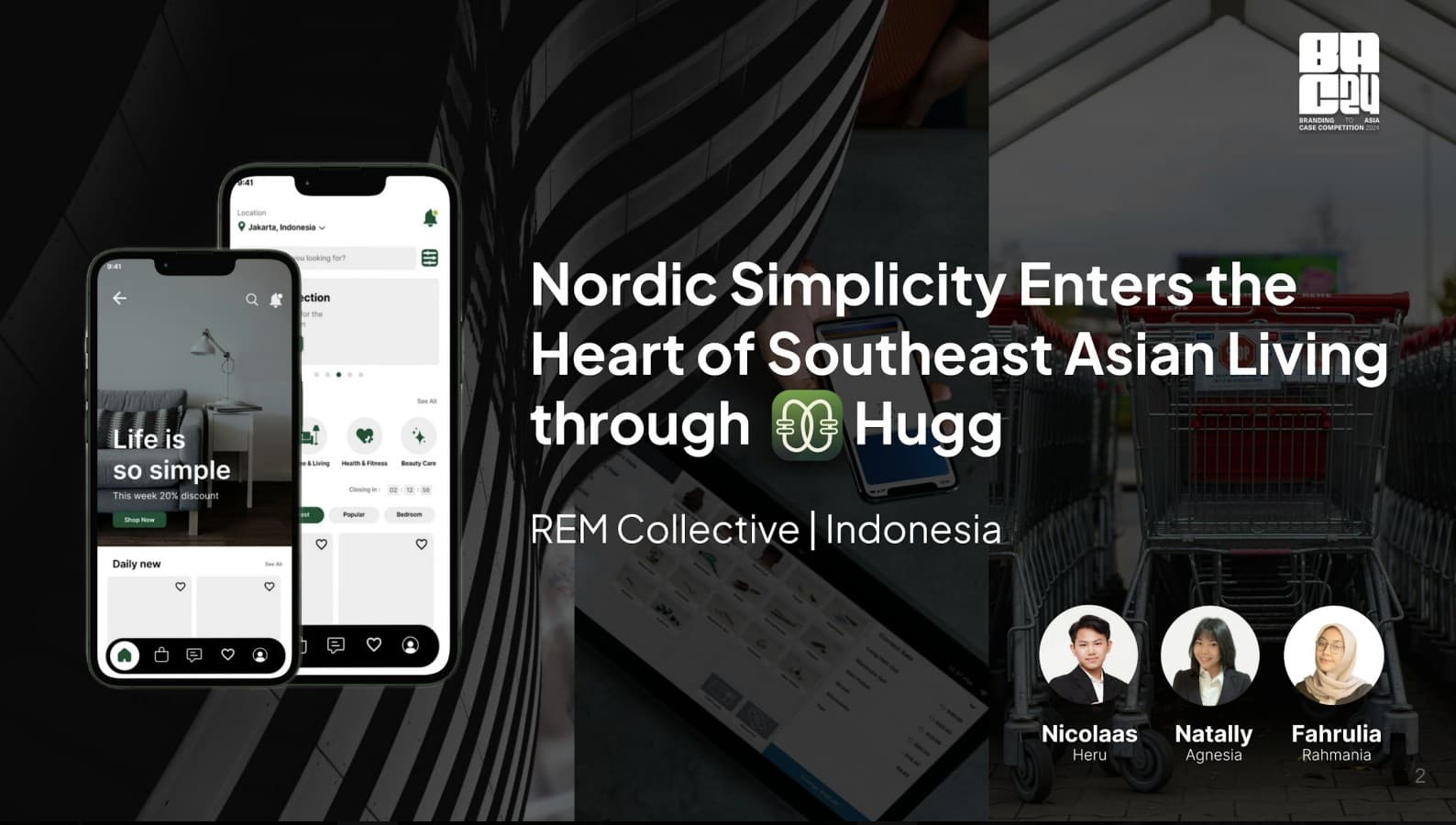
A market-entry and brand strategy for Hugg, a Nordic e-commerce brand entering Southeast Asia, that won 1st place at the Branding to Asia Case Competition.
Overview
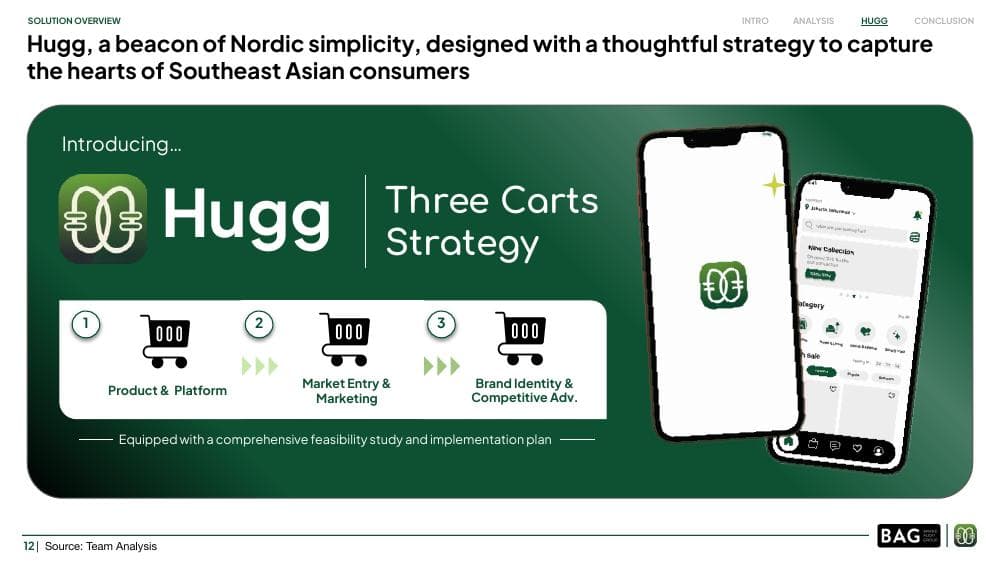
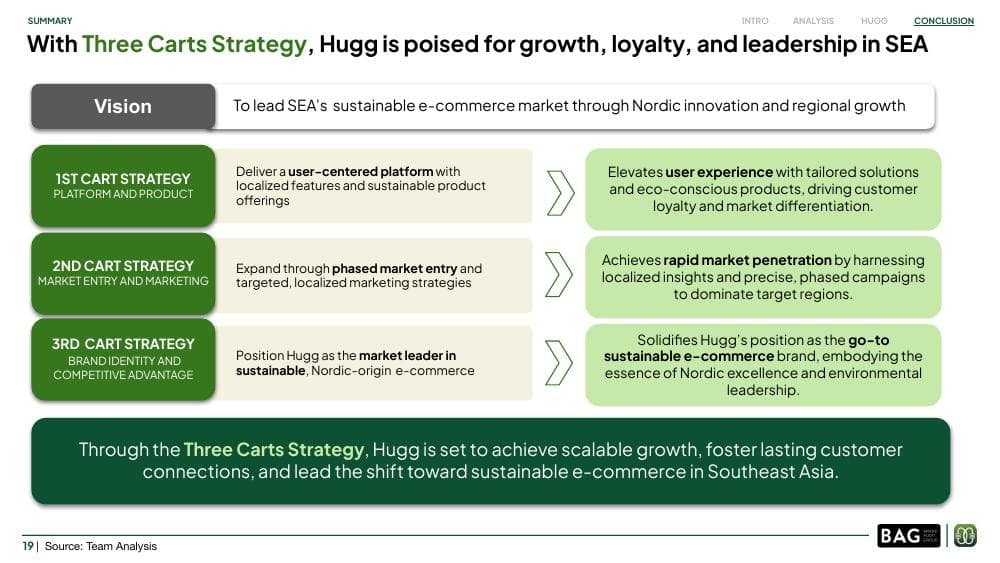
Hugg was a consulting-style case competition brief: design how a Nordic e-commerce brand should enter and win a share of Southeast Asia's e-commerce market. Our team, REM Collective, built a full go-to-market and brand strategy, the 'Three Carts Strategy', spanning platform and product, market entry and marketing, and brand identity, backed by a working app prototype and a 3-year implementation roadmap. The submission won 1st place.
Problem
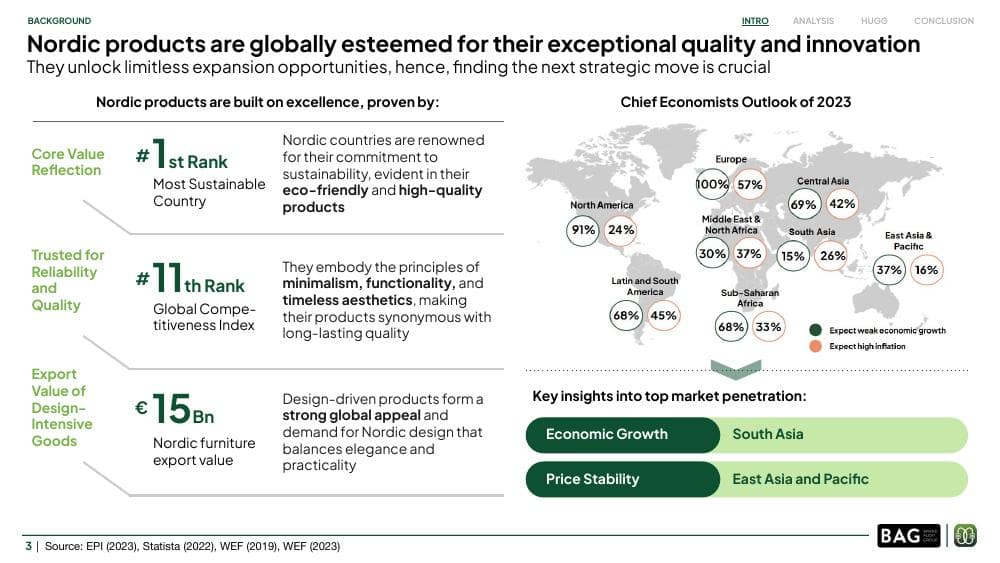
Southeast Asia's e-commerce market is large but saturated and price-driven, dominated by giants like Shopee, Lazada, Tokopedia, and Zalora. A Nordic brand entering the region needed a way to win share profitably without diluting its identity into just another discount marketplace, and without spreading a market-entry budget too thin across too many countries at once.
Solution
We narrowed 11 candidate Southeast Asian markets down to 5 priority countries (Singapore, Indonesia, Vietnam, Thailand, Malaysia) using growth, market-accessibility, and consumer-spending indicators, then built the Three Carts Strategy: (1) Platform & Product, a localized, user-first e-commerce experience prototyped end to end; (2) Market Entry & Marketing, a phased, three-country rollout driven by a push-pull framework that synchronizes Nordic brand supply with Asian customer demand; (3) Brand Identity & Competitive Advantage, positioning Hugg around Nordic minimalism, sustainability, and curated exclusivity in the least-saturated product categories (beauty, home & living, health & fitness) rather than competing head-on in fashion and electronics.
My Role
Prototype development, UI/UX, and product strategy. I designed and built the app prototype for Hugg's platform, owned the first-cart product and platform strategy, and contributed to the broader go-to-market and brand positioning work alongside Natally Agnesia and Fahrulia Rahmania.
Process
- 01
Market sizing & selection
Analyzed 11 Southeast Asian markets on economic growth, ease of doing business, and consumer spending power, narrowing to 5 priority countries.
- 02
Customer & competitor analysis
Mapped B2C and B2B customer segments and the full purchase journey, then benchmarked Hugg against Shopee, Lazada, Tokopedia, and Zalora to find underserved categories.
- 03
Platform & product prototype
Designed and prototyped Hugg's app experience, product discovery, comparison, one-click checkout, and localized payments, balancing Nordic identity with local expectations.
- 04
Market entry & marketing
Built a phased, three-country rollout plan around a push-pull funnel that synchronizes Nordic brand partnerships with Asian customer demand generation.
- 05
Brand identity & positioning
Defined Hugg's unique value proposition, sustainability, minimalist Scandinavian design, and curated eco-conscious materials, and six critical success factors.
- 06
Implementation roadmap
Built a 3-year phased implementation timeline with a risk and mitigation plan covering market adaptation, supply chain, and reputational risk.
Deliverables
- , Market-entry analysis across 11 Southeast Asian markets
- , B2C and B2B customer segmentation & journey maps
- , Competitor benchmarking vs. Shopee, Lazada, Tokopedia, and Zalora
- , App prototype (platform & product strategy)
- , Three Carts go-to-market and brand strategy
- , 3-year implementation roadmap & risk mitigation plan
Results
1st Place
Result
11 → 5
Markets analyzed
Branding to Asia
Competition
Gallery
“Hugg pushed me to hold two roles at once, the strategist scoping market entry and the builder prototyping what the customer would actually touch. Winning reinforced that a brand strategy only convinces a judge if you can also show, not just tell, what it looks like in the customer's hand.”